
Dearborn County Warrant Limits
No official source inspected exposed a complete searchable active-warrant portal for Dearborn County. The Dearborn County Sheriff's Office site gives public safety links, including Most Wanted, Sex Offenders, Inmate Search, Jail Information, Accident Report, and an app link. It also identifies Sheriff Shane J. McHenry and lists the Law Enforcement Center contact block. That sheriff site is useful, but the researched pages did not show a countywide search box that confirms every active arrest warrant, bench warrant, failure-to-appear warrant, or sealed warrant.
The safest Dearborn County warrant record chain is layered. Search the court case first if a case number, citation number, or party name is known. Check the sheriff's selected wanted-person list for public alerts. Then contact the court, Clerk of Courts, or Sheriff's Office when a warrant may affect a hearing, bond, surrender, or arrest risk. A missing public listing should not be read as proof that no warrant exists, especially for sealed warrants, fresh warrants, juvenile matters, or warrants tied to agencies outside Dearborn County.
For a criminal case, the court record may be more useful than the sheriff page. Indiana MyCase can show public docket entries in Dearborn Circuit Court, Superior Court I, or Superior Court II when the matter is not confidential. A chronological case summary may include missed hearings, bond changes, warrant activity, or recall entries if those events are public.
Dearborn County Warrant Channels
Official access varies by warrant type. The sheriff handles law-enforcement custody and public safety channels. The Clerk of Courts handles court-record copy and hearing questions for Circuit and Superior Court cases. City or town courts may be relevant if the case began as a municipal ordinance or traffic matter. The prosecutor handles felony and misdemeanor cases for the State, but the research does not identify the Dearborn/Ohio County Prosecutor as the normal warrant-confirmation line.
| Channel | Use | Source |
|---|---|---|
| Sheriff's Most Wanted | Selected public wanted-person alerts, not a full Dearborn County warrant search | Most Wanted |
| Indiana MyCase | Criminal, traffic, and infraction dockets where public warrant events may appear | MyCase |
| Clerk of Courts | Court date, case copy, and division-specific case questions | Clerk of Courts |
| Sheriff's Office phone or counter | Custody, surrender, law-enforcement, and records questions | Sheriff's Office |
| City or town court | Municipal ordinance or local traffic case if listed on the citation or MyCase record | Citation or court field |
The Dearborn County Clerk of Courts is at 165 Mary St, Lawrenceburg, IN 47025. The research lists the Circuit phone as (812) 537-8867 and the Superior clerk phone as (812) 537-8877. The Sheriff's Office is at 301 W High St, Lawrenceburg, IN 47025, phone (812) 537-3431, with office hours 8:00 a.m. to 4:00 p.m. Monday through Friday.
Note: Warrant confirmation can affect arrest risk, so use official agencies or counsel rather than third-party lookup sites.
Dearborn County Most Wanted
The sheriff's Most Wanted page is the clearest local public warrant-related page found in the research. It displays a public wanted-person list and a "View More" control. The official research also notes a Submit A Tip link in the sheriff site header. Those features make the page useful for public safety alerts and tip routing, but they do not create a complete Dearborn County active warrant database.
The manifest image for the warrant page comes from the sheriff's Most Wanted source.
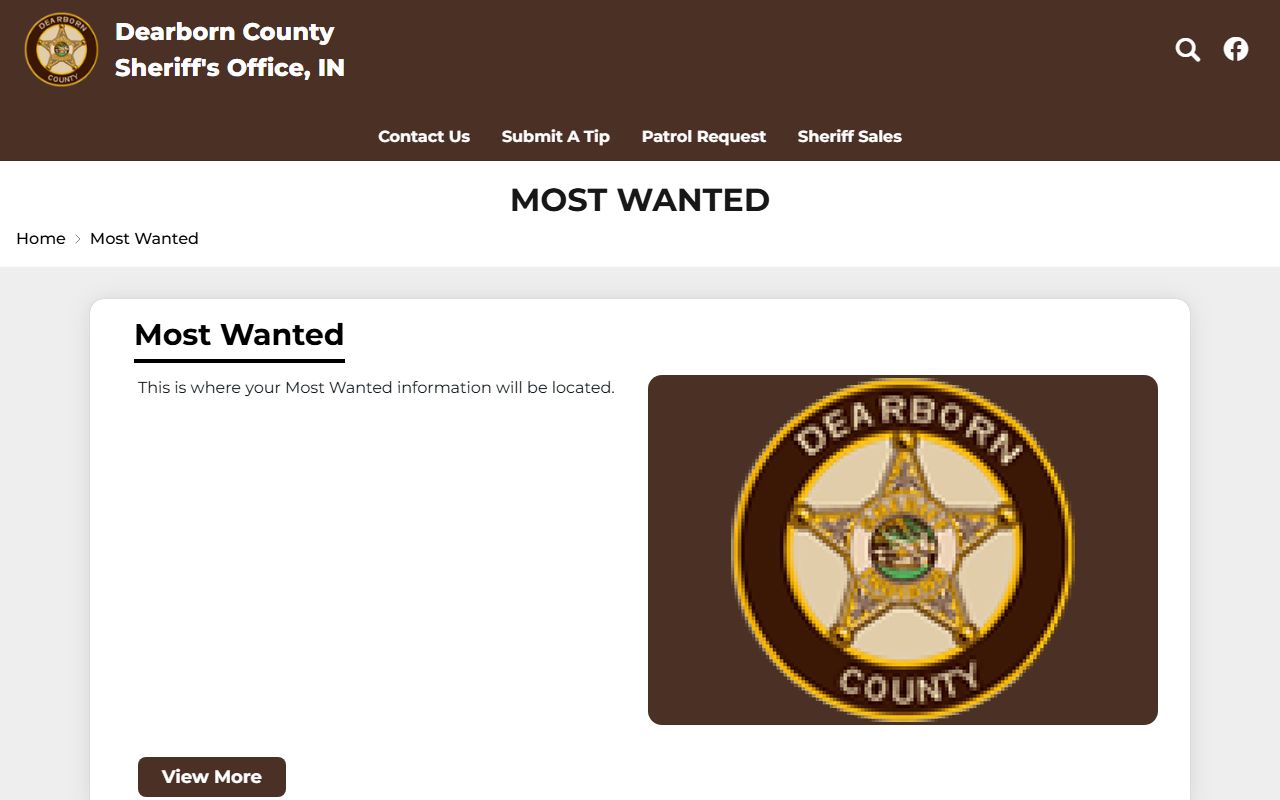
This Dearborn County warrant record source should be read as a selected law-enforcement list. A person absent from the list can still have a bench warrant, arrest warrant, out-of-county hold, or sealed warrant.
| Field Label | Type | Required | Options / Format Notes |
|---|---|---|---|
| Most Wanted listing | Clickable listing | No | Displays a wanted-person list; not a complete Dearborn County warrant database |
| View More | Button or link | Optional | Expands or pages through selected listings where available |
| Type to Search | Not visible in researched output | No | A search field was not confirmed for the Most Wanted page |
Dearborn County Warrant Fields
A public warrant-related listing may show less than a full court or agency file. The inspected sheriff source confirmed a public Most Wanted page and visible imagery, but several record fields were not confirmed in browser-readable text. That matters because warrant data is often event-based. A bench warrant may appear as a docket entry in MyCase. A wanted-person alert may show only enough detail for public identification. A sealed search warrant may not appear publicly at all before execution.
| Field | What It Shows |
|---|---|
| Name | Likely visible on an individual Most Wanted listing or public alert |
| Photo | Visible in the sheriff listing image area when provided |
| Charge or offense | Likely tied to the wanted-person entry, but not confirmed in plain browser text |
| Warrant number | Not confirmed in the researched public Most Wanted output |
| Issuing court | Not confirmed on the sheriff listing; check MyCase or the clerk when a court case exists |
| Bond | Not confirmed on the listing; may be set by court order or jail process |
| Tip/contact | Submit A Tip appears as a sheriff site channel for public information |
| Completeness limit | Most Wanted is a selected list and is not proof that no Dearborn County warrant exists |
The sheriff also publishes a local Sex Offenders page, which is related to public safety but is not the same as a warrant search. Sex offender registry records may show address and offender status, while a warrant record concerns a court or law-enforcement order.
The second warrant-page manifest image comes from the sheriff's local Sex Offenders source.
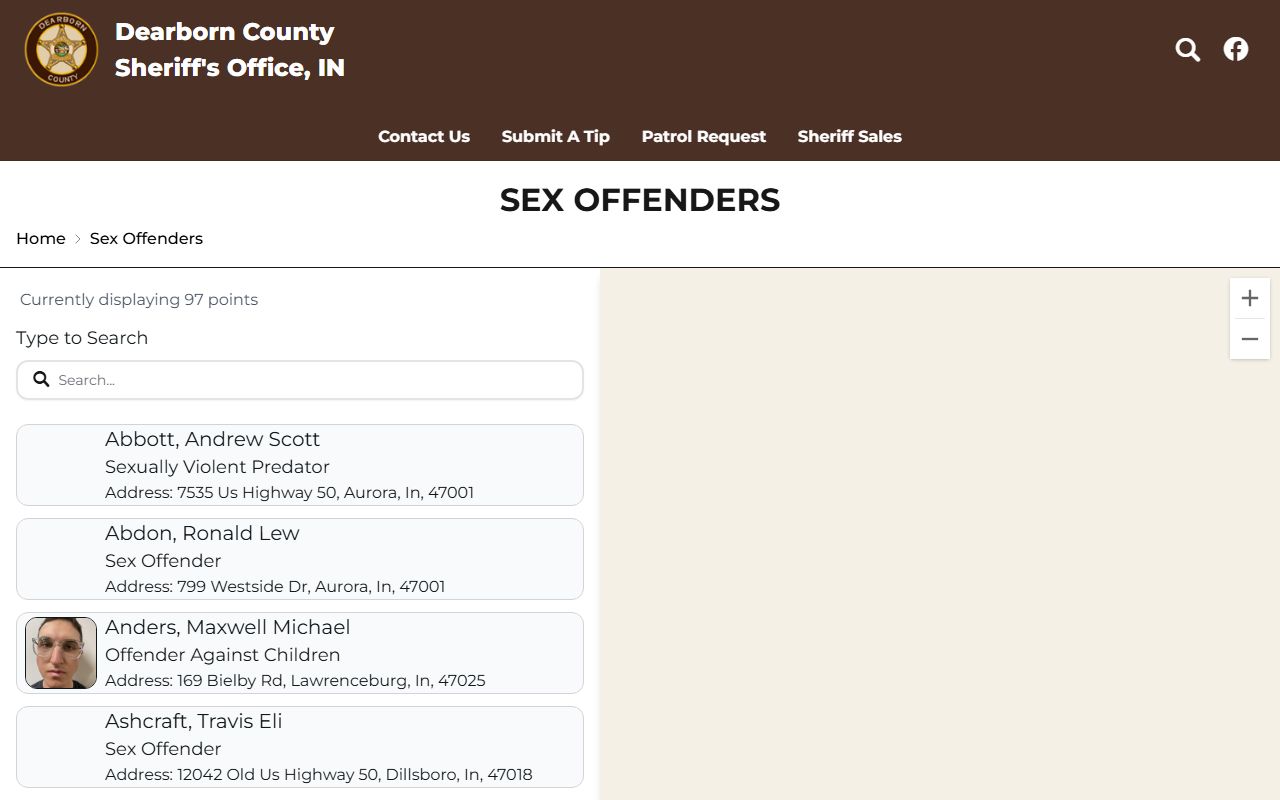
The registry source can help identify a separate public-record category, but it should not be used as a substitute for court or sheriff warrant confirmation.
Dearborn County Warrant Types
Different Dearborn County warrant records begin in different places. A judge may issue an arrest warrant after a probable-cause showing. A bench warrant can follow a missed hearing, failure to comply, probation violation, or contempt finding. A search warrant authorizes a search of a person, place, or property and may not be public before execution. A fugitive or out-of-county warrant may involve another jurisdiction and a hold in the Dearborn County jail.
- Arrest warrant
- A court order based on probable cause that allows law enforcement to arrest the named person.
- Bench warrant
- A judge-issued order often tied to failure to appear, failure to comply, probation violation, or contempt.
- Search warrant
- A court order that authorizes a search and may remain sealed or delayed from public view.
- Fugitive warrant
- A warrant or hold that may involve another county, state, or federal district.
- Failure-to-appear warrant
- A warrant or docket event that may follow a missed court date or unmet appearance duty.
Indiana pages may use warrant, bench warrant, and failure-to-appear wording. The research does not support importing Texas-specific "capias pro fine" language into this Dearborn County warrant page. Traffic citations and ordinance cases can still lead to court action if a person misses a required appearance.
Search MyCase for Warrants
MyCase is not a dedicated warrant portal, but it is often the best first check when the warrant is tied to a Dearborn County criminal, traffic, infraction, or ordinance case. A public docket may show a warrant issued, warrant recalled, bond set, failure to appear, hearing notice, or case status entry. Use the court field to distinguish Dearborn Circuit Court, Dearborn Superior Court I, Dearborn Superior Court II, or a city or town court if one appears.
- Open Indiana MyCase and choose a search mode.
- Search by case number if known, or by party name with a date of birth when available.
- Limit by court, case type, status, or filing date if too many results appear.
- Read the chronological case summary for public warrant, bond, hearing, or failure-to-appear entries.
- Call the Clerk of Courts or the listed court before assuming a docket entry is current.
MyCase has important limits. It does not display date of birth in public case details, does not show every document, and excludes confidential, sealed, expunged, juvenile, adoption, and protected-party information. It can also lag behind live law-enforcement status.
Resolve a Dearborn County Warrant
A person who may have an outstanding Dearborn County warrant should avoid relying on a private search result or an absence from the sheriff's Most Wanted page. First, identify the court case if one exists. Then use the court or clerk listed in the case to ask about hearing status, recall options, bond, or appearance duties. If the warrant is an arrest warrant rather than a missed-court bench warrant, counsel or the Sheriff's Office can help confirm surrender procedures.
Important: Contact counsel or the official agency before appearing in person when an active warrant may lead to arrest.
Bring identification if the agency or court asks for an in-person appearance. Bring an approved payment method only after the court or sheriff confirms that bond, fines, or costs can be paid. After a recall, arrest, bond posting, or court appearance, check the case again because updates may not post to public systems at the same time the order is signed.
Restricted Dearborn County Warrants
Some warrant records are not available through public channels. A search warrant may be sealed while an investigation is active. Juvenile matters are often restricted under Indiana juvenile record rules. Expunged, sealed, or confidential case records may not appear in MyCase even when an underlying law-enforcement history exists. Federal warrants are separate from Dearborn County court files and may involve the U.S. Marshals Service or federal court.
For court records, Indiana Administrative Rule 9 and Access to Court Records Rule 5 control many public access limits. For sheriff or prosecutor administrative records, the Indiana Access to Public Records Act may apply, but law-enforcement investigatory records can be restricted. Those limits are why official confirmation is more reliable than a broad web search.